A graph is a data structure that consists of a set of nodes connected by edges. Graphs are used to simulate many real-world problems, such as paths in cities, circuit networks, and social networks. This post is to implement a graph as an adjacency list.
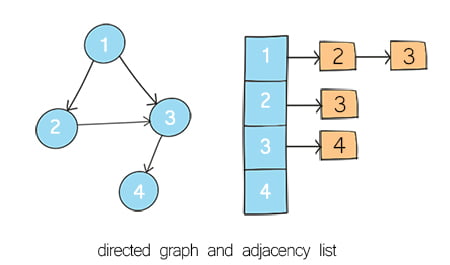
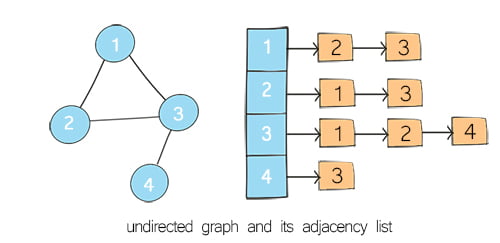
Table of Content
- Terminology
- Add node and edge
- Remove node and edge
- Search by node and edge
- Find path with DFS
- Find path with BFS
- Print graph as adjacency list
- Traverse with DFS
- Traverse with BFS
- Free download
Terminology
A node in the graph is also called a vertex. A line between two nodes is an edge. Two nodes are adjacent (or neighbors) if they are connected through an edge. A path represents a sequence of edges between the two nodes.
In a directed graph, all of the edges represent a one-way relationship. In an undirected graph, all edges are bi-directional.
If the edges in the graph have weights (represent costs or distances), the graph is said to be a weighted graph. If the edges do not have weights, the graph is said to be unweighted.
A graph can be presented as an adjacency list or adjacency matrix. An adjacency list is an array of edges or nodes. The adjacency list is used for the representation of the sparse graphs and is used more often. An adjacency matrix is a square matrix with dimensions equivalent to the number of nodes in the graph. An adjacency matrix is preferred when the graph is dense.
Add node and edge
First, we define a Graph class. The Graph class has two fields: adj and directed. adj is a HashMap in which the key is the node, the value is all its neighbors. The value is represented as a linked list of the nodes. directed is a boolean variable to specify whether the graph is directed or undirected. By default, it is undirected.
In many old implementations of adjacency lists, adj is defined as an array of node lists. The disadvantage of this implementation is that we have to define the length of the array first. To avoid this, we use a hashmap. By using hashmap, we can retrieve the node and its neighbors by node itself, not by index in the array. Note the node can be any data type, such as Integer or String, or a customer-defined graphNode class.
To add a node to the graph is to add a key in the hashmap. To add an edge is to add an item in this key’s value. The following method addEdge includes both adding a node and adding an edge. For a directed graph, we add an edge from a to b. For the undirected graph, we also add an edge from b to a.
Java
1 2 3 4 5 6 7 8 9 10 11 12 13 14 15 16 17 18 19 20 21 22 23 24 | public class Graph<T> { Map<T, LinkedList<T>> adj = new HashMap<>(); boolean directed; //Constructor, Time O(1) Space O(1) public Graph() { directed = false; //default, Undirected graph } //Constructor, Time O(1) Space O(1) public Graph(boolean d) { directed = d; } //Add edges including adding nodes, Time O(1) Space O(1) public void addEdge(T a, T b) { adj.putIfAbsent(a, new LinkedList<>()); //add node adj.putIfAbsent(b, new LinkedList<>()); //add node adj.get(a).add(b); //add edge if (!directed) { //undirected adj.get(b).add(a); } } } |
Javascript
1 2 3 4 5 6 7 8 9 10 11 12 13 14 15 16 17 18 | class Graph { //Constructor, Time O(1) Space O(1) constructor(directed) { this.adj = new Map(); this.directed = directed; //true or false } //Add edges including adding nodes, Time O(1) Space O(1) addEdge(a, b) { if (this.adj.get(a) == null) this.adj.set(a, new Array()); if (this.adj.get(b) == null) this.adj.set(b, new Array()); this.adj.get(a).push(b); if (!this.directed) this.adj.get(b).push(a); } } |
Python
1 2 3 4 5 6 7 8 9 10 11 12 13 14 15 | class Graph : #Constructor, Time O(1) Space O(1) def __init__(self, directed) : self.adj = {} self.directed = directed #true or false #Add edges including adding nodes, Time O(1) Space O(1) def addEdge(self, a, b) : if a not in self.adj: self.adj[a] = [] if b not in self.adj: self.adj[b] = [] self.adj[a].append(b) if (self.directed == False) : self.adj[b].append(a) |
Remove node and edge
The removal operation can be removing an edge or removing a node. To remove an edge, we use the first node as the key to find its neighbors in the hashmap. Then remove the second node from its neighbors. For a directed graph, we just need to remove the edge from a to b. For an undirected graph, we also need to remove the edge from b to a.
Java
1 2 3 4 5 6 7 8 9 10 11 12 13 14 15 | //Remove direct connection between a and b, Time O(1) Space O(1) public boolean removeEdge(T a, T b) { if (!adj.containsKey(a) || !adj.containsKey(b)) return false; //stop when input is invalid LinkedList<T> neighborsOfA = adj.get(a); LinkedList<T> neighborsOfB = adj.get(b); if (neighborsOfA == null || neighborsOfB == null) return false; //stop when no neighbors found boolean r1 = neighborsOfA.remove(b); if (!directed) { //undirected boolean r2 = neighborsOfB.remove(a); return r1 && r2; } return r1; } |
Javascript
1 2 3 4 5 6 7 8 9 10 11 12 13 14 15 16 17 18 19 20 | //Remove direct connection between a and b, Time O(1) Space O(1) removeEdge(a, b) { if (this.adj.get(a) == null || this.adj.get(b) == null) return false; var ne1 = this.adj.get(a); var ne2 = this.adj.get(b); if (ne1 == null || ne2 == null) return false; var index = ne1.indexOf(b); if (index < 0) return false; ne1.splice(index, 1); if (!this.directed) { index = ne2.indexOf(a); if (index < 0 ) return false; ne2.splice(index, 1) } return true; } |
Python
1 2 3 4 5 6 7 8 9 10 11 12 13 14 15 16 | #Remove direct connection between a and b, Time O(1) Space O(1) def removeEdge(self, a, b): if a not in self.adj or b not in self.adj: return False ne1 = self.adj[a] ne2 = self.adj[b] if ne1 == None or ne2 == None: return False if b not in ne1: return False ne1.remove(b) if (self.directed == False): if a not in ne2: return False ne2.remove(a) return True |
To remove a node, we have to remove all connected edges before removing the node itself. For an undirected graph, first, we get all the neighbors of the node. Then for each of its neighbors, remove itself from the value list. For a directed graph, we search all keys in the hashmap for their values and check whether this node exists in their neighbors. If it does, remove it. The last step is to remove the node as the key in the hashmap. Then this node is no longer in the hashmap’s key set.
Java
1 2 3 4 5 6 7 8 9 10 11 12 13 14 15 16 | //Remove a node including all its edges, //Time O(V+E) Space O(1), V is number of nodes, E is number of edges public boolean removeNode(T a) { if (!adj.containsKey(a)) //invalid input return false; if (!directed) { //undirected LinkedList<T> neighbors = adj.get(a); for (T node: neighbors) adj.get(node).remove(a); } else { //directed for (T key: adj.keySet()) adj.get(key).remove(a); } adj.remove(a); return true; } |
Javascript
1 2 3 4 5 6 7 8 9 10 11 12 13 14 15 16 17 18 19 20 21 22 23 | //Remove a node including all its edges, Time O(V+E) Space O(1) removeNode(a) { if (this.adj.get(a) == null) return false; if (!this.directed) { //undirected var ne1 = this.adj.get(a); for (let node of ne1) { let list = this.adj.get(node); let index = list.indexOf(a); if (index >= 0) list.splice(index, 1); } } else { //directed for (let entry of this.adj.entries()) { let list = entry[1]; let index = list.indexOf(a); if (index >= 0) list.splice(index, 1); } } this.adj.delete(a); return true; } |
Python
1 2 3 4 5 6 7 8 9 10 11 12 13 14 15 | #Remove a node including all its edges, #Time O(V+E) Space O(1), def removeNode(self, a): if a not in self.adj: return False if self.directed == False: #undirected ne1 = self.adj[a] for node in ne1: self.adj[node].remove(a) else: #directed for k, v in self.adj.items(): if a in v: v.remove(a) self.adj.pop(a) return True |
Search by node and edge
Search can be a search of a node, an edge, or a path. We can check whether there is a node existing in the graph. This can be done by simply checking if the hashmap contains the key. We can also check whether there is a direct connection between two nodes (aka whether there is an edge). This can be done by checking whether the second node is in the first node’s neighbors.
Java
1 2 3 4 5 6 7 8 9 10 11 12 13 14 15 | //Check whether there is node by its key, Time O(1) Space O(1) public boolean hasNode(T key) { return adj.containsKey(key); } //Check whether there is direct connection between two nodes, Time O(1), Space O(1) public boolean hasEdge(T a, T b) { LinkedList<T> ne1 = adj.get(a); if (directed) //directed return ne1.contains(b); else { //undirected or bi-directed LinkedList<T> ne2 = adj.get(b); return ne1.contains(b) && ne2.contains(a); } } |
Javascript
1 2 3 4 5 6 7 8 9 10 11 12 13 14 15 | //Check whether there is node with the key, Time O(1) Space O(1) hasNode(key) { return this.adj.has(key); } //Check whether there is direct connection between two nodes, Time O(1), Space O(1) hasEdge(a, b) { var ne1 = this.adj.get(a); if (this.directed) //directed return ne1.includes(b); else { //undirected or bi-directed var ne2 = this.adj.get(b); return ne1.includes(b) && ne2.includes(a); } } |
Python
1 2 3 4 5 6 7 8 9 10 11 12 13 14 15 16 | #Check whether there is node by its key, Time O(1) Space O(1) def hasNode(self, key) : return key in self.adj.keys() #Check whether there is direct connection between two nodes, Time O(1), Space O(1) def hasEdge(self, a, b): ne1 = [] ne2 = [] if a in self.adj: ne1 = self.adj[a] if self.directed : #directed return b in ne1 else : #undirected or bi-directed if b in self.adj: ne2 = self.adj[b] return b in ne1 and a in ne2 |
Find path with DFS
A more useful operation is to search the path. A path is a sequence of edges. There can be more than one path between two nodes. There are two common approaches: depth-first search (DFS) and breadth-first search (BFS). In this section, we use DFS and BFS to find out whether there is a path from one node to another.
Depth First Search starts from the source node and explores the adjacent nodes as far as possible before returning. DFS is usually implemented with recursion or stack. It is used to solve find path or detect cycle problems.
Java
1 2 3 4 5 6 7 8 9 10 11 12 13 14 15 16 17 18 19 20 | //Check there is path from src and dest //DFS, Time O(V+E), Space O(V) public boolean dfsHasPath(T src, T dest) { if (!adj.containsKey(src) || !adj.containsKey(dest)) return false; HashMap<T, Boolean> visited = new HashMap<>(); return dfsHelper(src, dest, visited); } //DFS helper, Time O(V+E), Space O(V) private boolean dfsHelper(T v, T dest, HashMap<T, Boolean> visited) { if (v == dest) return true; visited.put(v, true); for (T ne : adj.get(v)) { if (visited.get(ne) == null) return dfsHelper(ne, dest, visited); } return false; } |
Javascript
1 2 3 4 5 6 7 8 9 10 11 12 13 14 15 16 17 18 19 20 | //Check there is path from src and dest //DFS, Time O(V+E), Space O(V) dfs(src, dest) { if (this.adj.get(src) == null || this.adj.get(dest) == null) return false; var visited = new Map(); return this.dfsHelper(src, dest, visited); } //DFS helper, Time O(V+E), Space O(V) dfsHelper(v, dest, visited) { if (v == dest) return true; visited.set(v, true); for (let ne of this.adj.get(v)) { if (visited.get(ne) == null) return this.dfsHelper(ne, dest, visited); } return false; } |
Python
1 2 3 4 5 6 7 8 9 10 11 12 13 14 15 16 17 | # Check there is path from src and dest # DFS, Time O(V+E), Space O(V) def dfs(self, src, dest): if src not in self.adj or dest not in self.adj: return False visited = {} return self.dfsHelper(src, dest, visited) #DFS helper, Time O(V+E), Space O(V) def dfsHelper(self, v, dest, visited): if v == dest: return True visited[v] = True for ne in self.adj[v]: if ne not in visited: return self.dfsHelper(ne, dest, visited) return False |
Find path with BFS
Breath First Search starts from the source node and explores all its adjacent nodes before going to the next level of adjacent nodes. BFS is usually implemented with a queue. It is often used to solve shortest-path problems.
Java
1 2 3 4 5 6 7 8 9 10 11 12 13 14 15 16 17 18 19 20 21 22 | //Check there is path from src and dest //BFS, Time O(V+E), Space O(V), V is number of vertices, E is number of edges public boolean bfsHasPath(T src, T dest) { if (!adj.containsKey(src) || !adj.containsKey(dest)) return false; HashMap<T, Boolean> visited = new HashMap<>(); Queue<T> q = new LinkedList<>(); visited.put(src, true); q.add(src); while (!q.isEmpty()) { T v = q.poll(); for (T ne : adj.get(v)) { if (ne == dest) return true; if (visited.get(ne) == null) { q.add(ne); visited.put(ne, true); } } } return false; } |
Javascript
1 2 3 4 5 6 7 8 9 10 11 12 13 14 15 16 17 18 19 20 21 22 | //Check there is path from src and dest //BFS, Time O(V+E), Space O(V), V is number of vertices, E is number of edges bfs(src, dest) { if (this.adj.get(src) == null || this.adj.get(dest) == null) return false; var visited = new Map(); var q = new Array(); visited.set(src, true); q.push(src); while (q.length > 0) { let v = q.shift(); for (let ne of this.adj.get(v)) { if (ne == dest) return true; if (visited.get(ne) == null) { q.push(ne); visited.set(ne, true); } } } return false; } |
Python
1 2 3 4 5 6 7 8 9 10 11 12 13 14 15 16 17 18 | #Check there is path from src and dest #BFS, Time O(V+E), Space O(V) def bfs(self, src, dest): if src not in self.adj or dest not in self.adj: return False visited = {} q = [] visited[src] = True q.append(src) while q: v = q.pop(0) for ne in self.adj[v]: if ne == dest: return True if ne not in visited: q.append(ne) visited[ne] = True return False |
Print graph as an adjacency list
Print is to visit all nodes in the graph and print the information stored. It can be done by looping through the key set of the hashmap and printing the neighbors. This method is used for debugging purposes.
Java
1 2 3 4 5 6 | //Print graph as hashmap, Time O(V+E), Space O(1) public void print() { for (T key: adj.keySet()) { System.out.println(key + "," + adj.get(key)); } } |
JavaScript
1 2 3 4 5 6 | //Print graph as hashmap, Time O(V+E), Space O(1) print() { for (let entry of this.adj.entries()) { console.log(entry[0] + "-" + entry[1]); } } |
Python
1 2 3 4 | # Print graph as hashmap, Time O(V+E), Space O(1) def printGraph(self) : for k, v in self.adj.items(): print(str(k) + "-" + str(v)) |
Traverse with DFS
DFS traversal: Use depth-first search to visit nodes in the graph and print the node’s information. This is similar to DFS traversal in a binary tree. Starting from the source node, we call the recursive method to visit one of its neighbors, then a neighbor of the neighbor, and so on. Please note the source might be any node in the graph. Some nodes might not be reached in a directed graph. (In a binary tree, we always start from the root and all nodes should be visited.)
Java
1 2 3 4 5 6 7 8 9 10 11 12 13 14 15 16 17 18 | //Traversal starting from src, DFS, Time O(V+E), Space O(V) public void dfsTraversal(T src) { if (!adj.containsKey(src)) return; HashMap<T, Boolean> visited = new HashMap<>(); helper(src, visited); System.out.println(); } //DFS helper, Time O(V+E), Space O(V) private void helper(T v, HashMap<T, Boolean> visited) { visited.put(v, true); System.out.print(v.toString() + " "); for (T ne : adj.get(v)) { if (visited.get(ne) == null) helper(ne, visited); } } |
JavaScript
1 2 3 4 5 6 7 8 9 10 11 12 13 14 15 16 17 | //Traversal starting from src, DFS, Time O(V+E), Space O(V) dfsTraversal(src) { if (this.adj.get(src) == null) return; var visited = new Map(); this.helper(src, visited); } //DFS helper, Time O(V+E), Space O(V) helper(v, visited) { visited.set(v, true); console.log(v.toString()); for (let ne of this.adj.get(v)) { if (visited.get(ne) == null) this.helper(ne, visited); } } |
Python
1 2 3 4 5 6 7 8 9 10 11 12 13 14 | #Traversal starting from src, DFS, Time O(V+E), Space O(V) def dfsTraversal(self, src): if src not in self.adj: return visited = {} self.helper(src, visited) #DFS helper, Time O(V+E), Space O(V) def helper(self, v, visited): visited[v] = True print(str(v)) for ne in self.adj[v]: if ne not in visited: self.helper(ne, visited) |
Traverse with BFS
BFS traversal: Use breadth-first search to visit all nodes in the graph and print the node’s information. This is similar to BFS traversal in a binary tree. Starting from the source, visit all its neighbors first before visiting the neighbor’s neighbor. Please note the source might be any node in the graph. Some nodes might not be reached in a directed graph. (In a binary tree, we always start from the root and all nodes should be visited.)
Java
1 2 3 4 5 6 7 8 9 10 11 12 13 14 15 16 17 18 19 20 | //Traversal starting from src, BFS, Time O(V+E), Space O(V) public void bfsTraversal(T src) { if (!adj.containsKey(src)) return; Queue<T> q = new LinkedList<>(); HashMap<T, Boolean> visited = new HashMap<>(); q.add(src); visited.put(src, true); while (!q.isEmpty()) { T v = q.poll(); System.out.print(v.toString() + " "); for (T ne : adj.get(v)) { if (visited.get(ne) == null) { q.add(ne); visited.put(ne, true); } } } System.out.println(); } |
JavaScript
1 2 3 4 5 6 7 8 9 10 11 12 13 14 15 16 17 18 19 | //Traversal starting from src, BFS, Time O(V+E), Space O(V) bfsTraversal(src) { if (this.adj.get(src) == null) return; var q = new Array(); var visited = new Map(); q.push(src); visited.set(src, true); while (q.length > 0) { let v = q.shift(); console.log(v.toString() + " "); for (let ne of this.adj.get(v)) { if (visited.get(ne) == null) { q.push(ne); visited.set(ne, true); } } } } |
Python
1 2 3 4 5 6 7 8 9 10 11 12 13 14 15 | # Traversal starting from src, BFS, Time O(V+E), Space O(V) def bfsTraversal(self, src): if src not in self.adj: return q = [] visited = {} q.append(src) visited[src] = True while (len(q) > 0): v = q.pop(0) print(str(v) + " ") for ne in self.adj[v]: if ne not in visited: q.append(ne) visited[ne] = True |